

1. Incredible Fuel Efficiency
Compared to the 2-stroke outboards of its era, the 2000 Mercury 50 HP 4-stroke is an absolute fuel-sipper. You can spend a whole day trolling or cruising without constantly watching the gas gauge—or burning a hole in your wallet.
2. Quiet and Smooth Operation
If you are tired of the deafening roar and vibrating deck of old 2-strokes, this motor is a breath of fresh air. It idles quietly, meaning you can actually hold a conversation while underway, and it won’t scare off the fish when you’re slipping into your favorite cove.
3. Built Like a Tank (Yamaha Block Power)
Here is a fun piece of marine trivia: Mercury and Yamaha collaborated on these early 4-strokes. The 2000 Mercury 50 HP actually features a powerhead engineered by Yamaha, paired with a Mercury midsection and lower unit. This “best of both worlds” marriage resulted in a bulletproof engine block that routinely clocks thousands of hours if properly maintained.
The Cons: Potential Red Flags to Watch Out For
No outboard is perfect, especially after more than two decades on the water. Here is what you need to keep an eye on:
- The Carburetor Headache: Unlike modern fuel-injected (EFI) models, the 2000 model relies on four individual carburetors. If the boat sits with ethanol fuel, these carbs can gum up easily. Synchronizing and cleaning four separate carbs requires patience or a trip to a mechanic.
- Weight: At nearly 250 lbs, it is significantly heavier than a 50 HP 2-stroke of the same era. Ensure your boat’s transom is rated to handle the extra weight.
- Corrosion in Saltwater: If it was used primarily in saltwater, check the midsection and lower unit closely. Early 2000s clear-coats and anodes required meticulous rinsing to prevent galvanic corrosion.
Finding Replacement Parts: Why Dobson Parts is Your Go-To
Because these early 2000s four-strokes are getting older, sourcing genuine OEM parts from a local dealer can be a massive headache. Many components are either discontinued or carry a premium showroom price tag.
At Dobson Parts, we specialize in dismantling and stocking these exact, hard-to-find components. Since the 2000 Mercury 50 HP shares DNA with Yamaha, tracking down the right cross-compatible part number is crucial.
Right now, we have a selection of vital components specifically for the 40/45/50 HP 4-stroke models ready to ship. Search these exact OEM part numbers on our site to get your motor running perfectly:
- Mercury OEM Middle Choke Rod: Part #
8095972 - OEM Mercury Temperature Switch: Part #
828039 1 - Mercury Marine Thermostat Cover: Part #
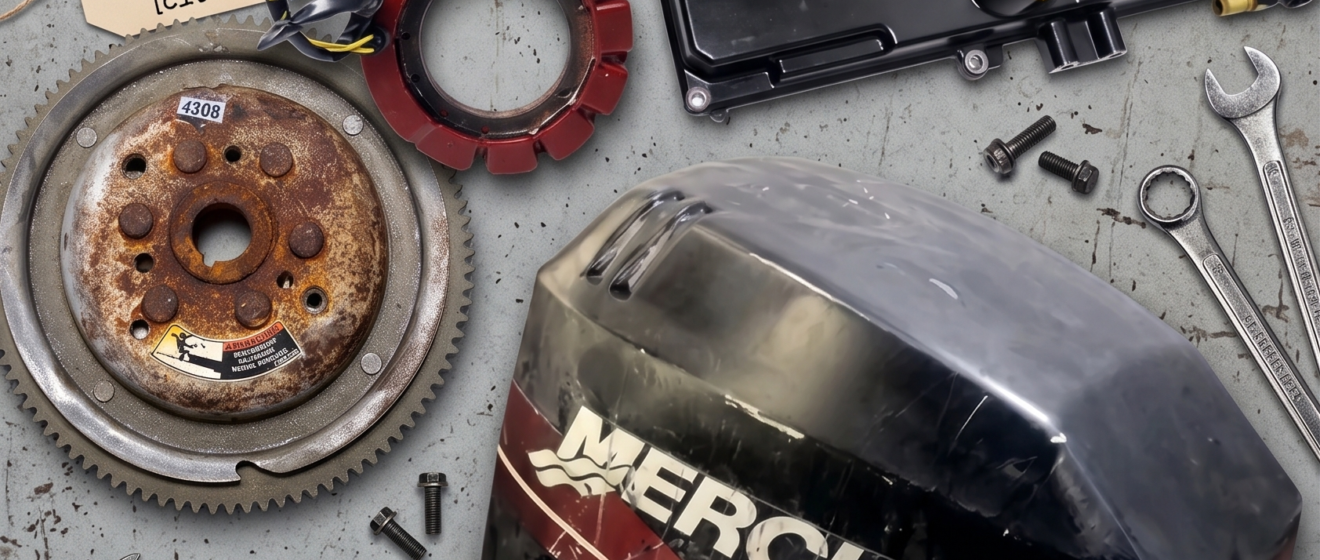
825031C - Mercury 40-60 HP (4-Stroke) Cover Assembly: Part #
825030A 1 - Mercury Tensioner (Yamaha Hybrid): Mercury Part #
824796A 1/ Yamaha Part #72Y-11590-00-00 - Mariner/Mercury Air Intake Silencer Box: Fits ’96-’00 40/45/50 HP 4-Stroke models
- Mercury 40-50 HP Flywheel: Part #
825090A2 - Mercury 50 HP Carburetor Joint Intake Plate: Part #
825077
Whether you are fixing a broken choke linkage, swapping out a corroded thermostat cover, or replacing that critical Yamaha-designed tensioner, we have the exact OEM pull you need.
Essential Maintenance Tips for Longevity
If you want to keep this motor purring for another decade, consistency is key. Treat these three tasks as non-negotiable:
3. Flush After Every Run: Even if you boat in freshwater, flushing the cooling passages with a set of “muffs” clears out debris and keeps the cooling channels clear.
1. Run Ethanol-Free Fuel Only: Because of the quad-carb setup, ethanol is your worst enemy. It attracts moisture and varnishes the tiny jets. Always use 90+ octane ethanol-free gas and a quality fuel stabilizer.
2. Change the Oil and Impeller Annually: Don’t neglect the lower unit gear lube and the engine oil. Replacing the water pump impeller every season ensures your engine stays cool and avoids catastrophic overheating.
Keep the carbs clean, change the oil, and head over to dobsonparts.com whenever you need to swap out a worn component to keep this classic Mercury out on the water for years to come.
 Account
 Categories
 Car filter
 Search
 Compare
 Top
Top